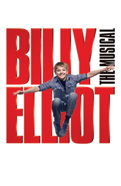
The Screen to Stage Triumph of Billy Elliot

It all started with a boy in a pink tutu.
That powerful visual crashed down on then-unknown writer Lee Hall one day in the late 1990s, the product of divine inspiration, or maybe luck. “I had this image in my head of a little boy on the streets of this particular village in England in a tutu, but I didn’t know why,” the scribe explains to Broadway.com via phone from the Imperial Theatre, where the boy from his daydream, now embodied by three precocious young actors in the musical Billy Elliot, is preparing to open on Broadway on November 13. But it takes more than a vision and pink tulle to create one of the most successful musicals in modern history, let alone one based on a screenplay that almost went unmade. So how did a peculiar story that BBC execs felt no one would want to see, pirouette out of the show-biz dregs and onto stages around the world? With some help from Hall, Broadway.com discovered it took persistence, luck…and a few thousand boys in ballet shoes.
Blue-Collar Beginnings
The story of Billy Elliot is, mostly, the story of its author. Born in Northeast England’s industrial Newcastle, Hall was raised in a blue-collar home just outside County Durham, the area that inspired Billy Elliot’s fictional town of Everington. Like Billy, Hall, the son of a shipbuilder and grandson of a miner, was creatively wired, a child who preferred drama and poetry to “manly” exploits like sports and fighting—a fact that did not always sit well with the family.
“I came up against expectations that writing wasn’t a job I should consider,” Hall says. “There was a lot of prejudice and a lack of understanding. So I suppose that writing was my ballet.” But there were bigger obstacles on the horizon than family approval.
In 1984, Conservative Prime Minister Margaret Thatcher took on the coal mining unions, announcing that, in order to subsidize the industry, the government would close 20 British mines, terminating tens of thousands of jobs. The announcement enraged workers and triggered the 1984 Miners’ Strike, which sparked a class war in Hall’s own backyard.
“There was a split in the 1980s: the prosperous South, and a depressed economy in the North where the big industries were,” explains Hall. “Times were incredibly hard.” Mining families went for an entire year without wages. Non-mining families Hall’s included held fundraisers to provide strikers with food and clothing. Meanwhile, pickets sparked violence across the country between protestors, “scabbers” workers who broke the strike for wages and government controlled police. “It felt like there was a civil war coming,” Hall recalls.
The strike, no real-life musical, did not have a happy ending. On March 3, 1985, Thatcher’s pit closure program won; the strike ended and mines began to close around the country. “There were about half a million miners before the strike,” Hall says. “I think the number now is just in the thousands. It was a watershed moment in British history.”
The Boy in the Tutu
The strike and its scars deeply affected Hall. After departing Newcastle as a young aspiring playwright, he began to shape the story of boy with a dream from a village in turmoil.
“The story was about my childhood, but I thought writing might be boring to watch on stage or film,” he explains with a laugh. Cue the vision of the pink tutu. “It came together once I worked out what that boy’s story could be. Dancing and ballet seemed a good metaphor for wanting to write.” The first draft of Billy Elliot in which Billy’s Mum was still alive was finished within three weeks.
The devil was in the details. The long script needed trimming. Mum was the first to go, becoming Dead Mum, as she’s lovingly called in the stage version. Hall also interviewed Royal Ballet School students from small villages, fleshing out his story with their experiences. The refined screenplay found support at BBC Films. Then someone hit the brakes.
“[The BBC] said ‘Nobody will watch a film about a miner’s strike, and they certainly won’t watch a film about a boy who wants to be a ballet dancer!’” Hall recalls. “I thought, ‘Have I gone mad? Why did I write a movie no one wants to see?’” Luckily, his next call was to old friend and successful stage director Stephen Daldry, who volunteered to direct the piece himself. Via a previous development deal with Working Title Films Elizabeth, Notting Hill, Daldry put the script into the hands of producers Jon Finn and Eric Fellner. Choreographer Peter Darling, a former colleague of Daldry and Hall, was tapped to give the film its vital leaps and turns. Billy was on the move.
An Unlikely Fan
For the film to succeed, the creative team needed one pitch-perfect element: its title star. More than 2,000 boys were seen during the original auditions, with the creative team scrutinizing every detail, from height to accent to dancing. The needle in the haystack was Jamie Bell, a 13-year-old hoofer from Billingham. The young talent rounded out a cast including Academy Award nominee Julie Walters as Billy’s dance teacher, Mrs. Wilkinson.
Asked if they had any inkling they were sitting on a winner during filming, Hall bursts out laughing. “We thought it was terrible,” he says almost gleefully. “We thought no one would want to see it because it was such a minority subject.” All that changed, however, when the finished film headed to Cannes.
Billy Elliot debuted at the famous film festival on May 19, 2000. The first feature film ever by its creative team, Billy received a two minute standing ovation and was bought within 24 hours by major film distributors around the world. Among the weeping audience members was one particularly notable Brit: Sir Elton John. “Weirdly, Elton approached us after the screening and said ‘I think this should be a musical.’ We were all a bit stunned,” Hall remembers.
Three Academy Award nominations and one year later, Sir Elton met Hall and Daldry for a surreal business meeting at Harry’s Bar in New York’s Waldorf-Astoria Hotel. John volunteered to write the music, stating that the original creatives should adapt the piece for the stage. “I thought he’d offer to get Bernie Taupin to do the lyrics and we’d be done, but he pointed directly at me and said ‘You have to do it,’” Hall says. “I was completely terrified.”
Which was how Hall, the boy from Newcastle, found himself sitting at Elton John’s custom-made piano writing songs with the Rocket Man himself. Hall would jot lyrics, pass them to John, make brief revisions together, then John would disappear into a smaller room to write the music. His longest composition took just 20 minutes. The result was a critically acclaimed pop-rock-folk score that captured the unique world of Billy, from the characters’ distinctive Geordie accent to the “solidarity” of a community at war with its own government no easy feat for any show tune, let alone ones that stick in your head.
As the stage adaptation developed, a second worldwide hunt for a live action Billy Jamie Bell was too old to reprise the role was on. Choreographer Darling scoured dance schools across the nation, eventually developing a short list of 10 boys. Due to child labor laws, the West End production needed three sets of Billys, as well as a trio of Michaels Billy’s pal and a trio of Debbies Mrs. Wilkinson’s daughter and three sets of dancing ballet girls, resulting in triple the rehearsals and the need for a boarding home for the show’s dozens of children. Add in technical malfunctions and the fact that the original draft ran over three hours, with a music-heavy first act and drama-laden second—sleepless nights abounded.
But, like Billy, the team soldiered on.
Electricity!
A revised and shortened Billy Elliot: The Musical, starring James Lomas, George Maguire and Liam Mower as Billy, Haydn Gwynne as Mrs. Wilkinson, Tim Healy as Dad, Joe Caffrey as Tony and Ann Emery as Grandma, officially opened at the Victoria Palace Theatre on May 11, 2005. The show’s opening night trumped the film’s debut, with ticketholders reporting a 10 minute tearful standing ovation.
Three years later, the ovations haven’t stopped. Billy Elliot nabbed Olivier Awards for Best New Musical, Best Choreographer and Best Actor in a Musical making Lomas, Maguire and Mower three of the youngest winners in history, as well as six other nominations. The production has sold more than a million tickets since opening, and remains the hottest show on the West End, with another company in Sydney, Australia.
The phenomenon also had an effect few would have predicted: a surge in male ballet dancers. In 2002, the Royal Ballet School announced that for the first time in its 76-year history, more boys than girls were accepted, and numbers of male auditionees continue to rise. The school attributed the jump in applications to The Billy Factor a fact that makes Hall very proud.
Broadway Billy
And now Billy Elliot is hitting Broadway. David Alvarez, Kiril Kulish and Trent Kowalik, the trio of talents produced by yet another global search, round out a cast of more than 50 including Olivier Award-nominated original cast member Haydn Gwynne, reprising the role of Mrs. Wilkinson, all poised to present Britain’s big musical to the savviest audiences in America.
“When we got to New York, the three of us [Darling, Daldry and Hall] sat down again and said ‘We’re here. Now we have to make this better.’ We couldn’t just put on the show we’d done in London,” Hall says of adapting to Broadway.
Cuts have been made to shorten the running time. Accents were adjusted to make the Geordie dialect friendlier to American ears. Musical numbers have been rechoreographed. But Billy’s core is the same, and, strangely enough, the show may be better suited for New York audiences than ever before.
“Being in America right now, when you can see hardship around you on the six o’clock news, so many of Billy’s themes are sadly relevant,” Hall said. “The show’s encouragement of individual achievement [has always] been a very strong part of American culture, even more so than in Europe. So we’re all honored, and very intimidated, to bring the show here. All that’s left to do is hold on for the ride.”