
Carrie Coon on the Subversiveness of Bug, Working With Husband Tracy Letts and The Gilded Age Season 4


(Photo: Heather Hazzan)
Nobody would claim that Who’s Afraid of Virginia Woolf? is a romance, but Edward Albee’s scalding classic spurred the real-life love story of playwright/actor Tracy Letts (a 2013 Tony winner as George) and his co-star Carrie Coon (a Tony nominee as Honey). After marrying in September 2013, Letts continued to combine writing and acting (most recently in Kathryn Bigelow’s thriller A House of Dynamite) while Coon became a small-screen star (The Leftovers, The White Lotus, The Gilded Age). On stage, she gave an indelible performance in the 2017 off-Broadway premiere of Amy Herzog’s Mary Jane. Eight years and one pandemic later, Coon is back on Broadway in a revival of Bug, her husband’s nail-biter of a psychological drama.
Cast as a lonely waitress with an abusive ex, Coon finds herself drawn into the conspiracy theories of a Gulf War veteran played by Namir Smallwood (Pass Over), who swears that their shabby motel room is infested with insects. Though the play was first performed in 1996, Bug seems ripped from the headlines in its portrayal of paranoia and PTSD. Early in previews at Manhattan Theatre Club’s Samuel J. Friedman Theatre, Coon reflected on the pleasure of collaborating with her husband and co-starring with a boatload of Tony winners and nominees in The Gilded Age.
Before we talk about this Broadway revival, how audacious was Tracy to write a play and call it Bug?
Well, he was 30, so I don’t think he was worried about that. [Laughs] He was writing for his friends at a tiny black box theater in Chicago. I think he had an irreverent spirit, and he wanted theater to be accessible to working class people—he wanted it to be funny and interesting and substantive. It wasn’t just salaciousness; these were real people that he understood.
What do you admire about the script?
It’s totally unhinged, but the bones of it are so solid. The relationship between the characters is accelerated—it’s only six scenes and one set—but if you dig into the form of it, it’s tightly constructed. And the language is so prescient, when he’s talking about how we will never really feel safe again. People can’t believe it was written 30 years ago.

What excites you most about doing Bug in a Broadway theater?
I like the fact that, maybe because of The White Lotus, there’s an interesting mix of audience members. We’re getting the staid, subscriber house, who we rely on to keep the American theater alive and who know Tracy’s work, but also young people who have never been to the theater. That’s exciting, and it feels subversive, in a way, to bring this kind of gnarly, gross theater to the people. It feels subversive to be an artist again.
How do you avoid conflict when you are acting in one of your husband’s plays? Can you leave your work at the theater?
Oh yeah. We have young children, so our lives are so logistical anyway, just trying to track the comings and goings of everyone. But we don’t mind talking about work. Tracy came to the show yesterday afternoon, and it’s not that he is giving me notes, but we can talk about the performance in an honest, deep way, about what’s working and not working. He dropped a few things in the hopper that were very supportive and that I was able to bring to the show last night. It’s not a violation of [director] David [Cromer] because Tracy and David have worked together so much, and Tracy is very respectful of David’s process. But every now and then, he will give me something that energizes the show in a new way.
You and Tracy are one of the best showmances.
We are kind of a great showmance! They don’t always work out; you realize you were in love with a character and not a person, but Tracy and I were not playing opposite each other [in Virginia Woolf], so we didn’t have that problem.

Why do you think Tracy is so skilled at writing female characters?
They’re all him, on some level. Tracy was very close to his mother, Billie Letts, who was an extraordinary woman. She became a novelist late in life, which was kind of a renaissance for her. Her book [Where the Heart Is] was picked up by Oprah’s Book Club, which gave her this career, and money, overnight. His family was very loving and affectionate but also very challenging. They had hard conversations about culture and music and art and politics; his mother was very political. Tracy deeply respects women, is curious about them and believes they are the superior gender. It always cracks me up when people see his plays and accuse him of misogyny because he’s reflecting the way women are treated in our culture. He’s just very, very empathetic.
When you were offered The White Lotus, which filmed in Thailand, Tracy’s response was, “We’ll make it work.” I’m sure that flexibility went both ways when he did A House of Dynamite.
He’s so vivid in that [Netflix movie], and also in The Lowdown on FX, which he wanted to do because he’s from Oklahoma. Tracy and I always understand what the undeniable jobs are, and we make them work for each other. He’s not going to win any medals, but it’s not necessarily typical in a marriage that the man also cooks and cleans and takes care of the kids and puts them on the school bus. Tracy is not a writer isolated from us in his ivory tower; he’s in the muck with me, doing the work, which is frankly the model of marriage I had growing up. My parents had a surprisingly egalitarian marriage for the '80s, so I wouldn’t have had it any other way.
"It’s totally unhinged, but the bones of it are so solid." —Carrie Coon on “Bug”
August: Osage County is ripe for revival...
It’s overdue!
Would you like to play Barbara, the eldest sister?
Yes, I would. We’ve done some readings of it. Economically, it’s a very challenging show because of the way theater has changed [since 2007]. I don’t know that August would make that move now from Chicago with a bunch of unknown theater actors. The business has shifted so much, you need an A-lister to play [the fiery matriarch] Violet to get a proper Broadway revival on its feet. Arguably, we wouldn’t be doing Bug here if I hadn’t done The White Lotus. But it’s something we’re actively working on, because I think people will be startled by the language in the play, in the way they’re startled by the language in Bug.
Speaking of The White Lotus, were you surprised by the intense chatter about your character’s frenemy relationship with Michelle Monaghan and Leslie Bibb?
I was. When I read the scripts, which I had to do before deciding to leave my family for six months and go to Thailand, I understood that their friendship was the heart of the season. But I had no idea of the number of essays and think pieces and online discourse it would inspire. That was really fascinating and moving. When you have kids and work and a marriage, it’s hard to cultivate and nurture female friendships. People in their 40s and into their 50s are straddling taking care of their parents and figuring out what’s meaningful in their lives.
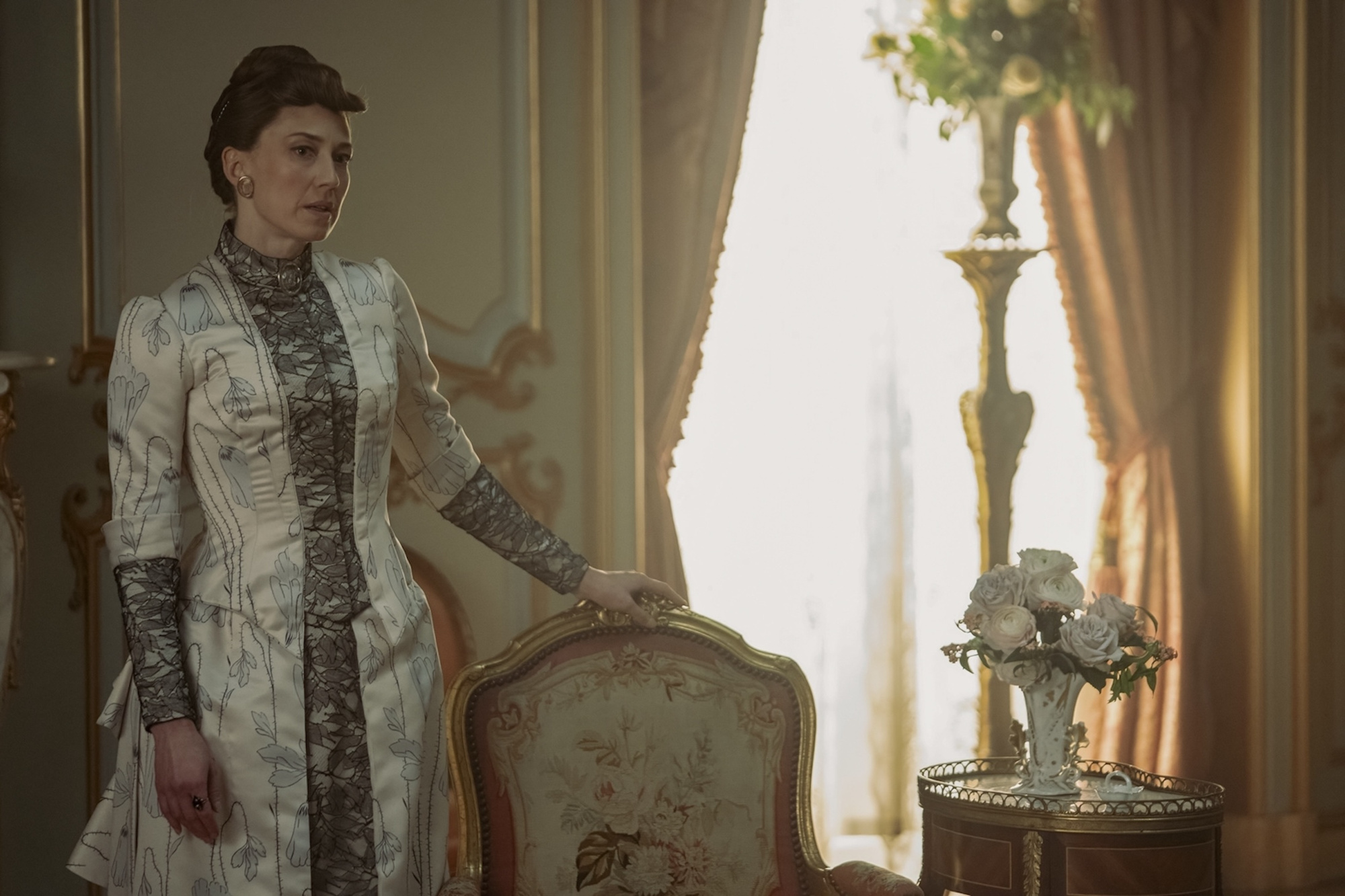 Carrie Coon as Bertha Russell in HBO's "The Gilded Age" (Photo: Karolina Wojtasik/HBO)
Meanwhile, you and Morgan Spector are the internet’s favorite sexy couple on The Gilded Age. When things went wrong between you, viewers got really upset.
We didn’t like it either! We love our healthy TV marriage, so we were sad about it, too. We’re going to start reading scripts soon for season four, and I don’t know where they’re taking us. People keep asking me, but I have no idea.
I tried to count the Tony nominations and Tony wins among the cast and finally had to give up.
It’s a real Broadway Bingo. We’re as excited as you are to see who gets pulled into our orbit. It’s always astonishing who signs up to do even one episode or a small arc.
Who is the most theatrical member of the cast off-camera?
Everybody wears their theatricality differently. There are so many great stories, like Christine Baranski having played Cynthia Nixon’s mother on stage [42 years ago] in The Real Thing. And [me] being pregnant [in real life] and dancing in a hoop skirt. I would say maybe Mrs. Astor—Donna Murphy. She’s just the best; everybody is the best. We have a great time.
Get tickets to Bug!


