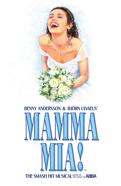
Mamma Mia! Here We Go Again–Get to Know the Story Behind the Iconic ABBA Musical Before It Returns to Broadway


(Photo: Joan Marcus/NYPL)
It’s been almost 25 years since Mamma Mia! made its Broadway debut at the Winter Garden Theatre, and nearly 10 years since the show had its last curtain call. But this summer, Mamma Mia! is coming home. Here’s a closer look at how the little ABBA jukebox musical-that-could became an unexpected international smash hit.
That’s Her Destiny
In the 1980s, producer Judy Craymer met and worked with founding ABBA members Björn Ulvaeus and Benny Andersson on the musical Chess. Craymer says she was “instantly smitten” upon meeting the pair and determined to work with them. Early on, Craymer recognized the theatrical storytelling that took place across ABBA’s songs. The idea for a play based on ABBA’s music all started with “The Winner Takes It All,” the lead single off of ABBA’s 1980 album Super Trouper and a devastating break-up song, written by Ulvaeus in the wake of his divorce from fellow ABBA member, Agnetha Fältskog. “I’ve wanted to sing “The Winner Takes It All” to every ex-boyfriend I ever had,” Craymer said in Vogue’s 2023 oral history of Mamma Mia! “Long before I had a plot, I knew that song would be the explosive, 11-o’clock ballad that sends audiences into ecstasy every night.”
Take a Chance On Me
Despite Craymer’s excitement to make a musical, it took some convincing. She initially pitched Ulvaeus and Andersson a TV special loosely based around the dynamic Swedish pop group’s songs, but they weren’t on board, wary of the criticism of their Europop style amid the burgeoning New Wave movement. But in 1992, the band’s music got a new life when the compilation album ABBA Gold was released, reminding old listeners (and showing new fans) that a well-produced and incisively written, feel-good pop song is nothing to turn up your nose at. With some more persistence on Craymer’s part, Ulvaeus and Andersson agreed that with the right librettist, there could be something. Catherine Johnson turned out to be the perfect fit.

Dream Team
It was Craymer’s idea to make a multigenerational musical, inspired by the tonal shift from ABBA’s earlier work, which had a youthful sound, to their later work, which transitioned into more mature lyrics and subject matter. Johnson suggested the story follow a mother and daughter in the lead-up to the daughter’s wedding. “What if the daughter is getting married but she doesn't know who her dad is—and there are three possible dads?” Johnson recalls saying to Craymer. “Judy just looked at me and said, ‘Sit back down.’”
British theater director Phyllida Lloyd was next to join them team. While Lloyd had no intention of ever doing a commercial musical, an “incredible meeting” with Craymer and Johnson sold her on the project. “We were all very much girls of a certain age who shared an immediate sense of humor,” Lloyd said. Craymer commented in a 2017 interview, “It was unusual, if not unheard of, for three women to be the collaborative creative force behind what was to become such a commercial success. Appropriately,” she added, “Mamma Mia! features three strong women in the story. Their characters are completely different—slightly bossy, a bit chaotic, extremely practical and very high maintenance.”
Opening Night
Mamma Mia!’s original working title was Summer Night City, which is what it was still called during its London previews in 1999. According to Ulvaeus, the “city” part never felt right, so they took out a globe to find the perfect island for it setting, landing on Greece. As for the title, Ulvaeus says that no other song title worked the way “Mamma Mia!” did, so despite the phrase’s Italian origins, it stuck for the Greek musical. With contemporary musicals beginning to make waves, the chances of success were still up in the air. But despite the show’s divergence from the norm, the first preview was a hit. On opening night, April 6, 1999 at the Prince Edward Theatre in London’s West End, it was clear they had created something special. As Craymer recalled, “The audience were charmed and one British critic wrote, ‘Mamma Mia! could put Prozac out of business.’”

A Detour to Broadway
While Broadway was eager for Mamma Mia! to make its way to New York City, the production team was gun shy. Despite London’s warm reception, Ulvaeus was still scarred in the aftermath of his previous musical, Chess, which received a negative New York Times review and closed quickly: “I said there was no f**king way we were taking Mamma Mia! to Broadway until it was totally critic-proof.” Craymer was more enticed by the idea of Broadway, but was open to taking the long way there. They brought the show to Toronto in May of 2000, and from there, organized a U.S. tour, starting in San Francisco in November of the same year, stopping in Los Angeles and ending in Chicago in August 2001.
It wasn’t until October 5, 2001 that Mamma Mia! started previews on Broadway, officially opening October 18. The timing worked in its favor, becoming a much-needed source of fun and light in the wake of 9/11. One of their grateful audience members was none other than the silver screen’s future Donna, Meryl Streep, who sent a thank-you note to the cast after making the show the main event of her then-10-year-old daughter Louisa’s birthday celebration. “We were all dancing in the aisles and down the street…We bought the cast album and sang the songs for two years,” she said in an interview with IndieLondon. “That’s why I wrote the note to the cast. To basically say, ‘Thank you for the music and for the injection of joy that was so needful at that moment.’”

(Photo: Universal Pictures)
Let’s Make a Movie
It wasn’t long before the Mamma Mia! team was approached to make a film adaptation, but they were hesitant about bringing their show to the silver screen, claiming that they’d only want to take that route when the musical started to lose buzz. The glowing reception to Rob Marshall’s 2002 big-screen adaptation of Chicago, which prompted a major jump at the Broadway box office, inspired a change of heart. Husband-and-wife duo Tom Hanks and Rita Wilson reached out to inquire about the rights to the film through Hanks’ production company with Gary Goetzman, Playtone. Much like the road to making the musical, the movie took a few years and some wheel-greasing, but once it was settled, Craymer got her wish: The stage team held the reins and resumed their respective producing, directing and writing roles. And with mega-fan Meryl Streep on board as the lead, the pieces fell into place. The film was a bona fide, record-breaking hit upon its 2008 release, and its 2018 sequel, Mamma Mia! Here We Go Again, was similarly successful.
World Tour
Since its debut in London in 1999, Mamma Mia! has been performed in 60 countries, from Argentina to Indonesia to Lithuania to Sri Lanka. The show has been translated into over 20 other languages, starting with German, for its 2002 production at the Operettenhaus in Hamburg, which drew in 2.5 million people over the five years it played. Other translated productions took place across Italy, Spain, the Netherlands, Korea, France and more. One of the show’s biggest international translation feats was its July 2011 debut in Shanghai, China, which, Craymer notes, “took literally years of planning and negotiating as well as actual political change within the People’s Republic” to come to fruition. The musical’s Broadway return now comes on the heels of its 25th anniversary North American tour, which recouped its $4.25 million investment in just 13 weeks. Running from August 2 through February 1, 2026 at the Winter Garden, its home of 14 years, the show ready to prove to a new generation that pop tunes and flare pants never go out of style.