Wicked by the Numbers: Broadway’s Emerald Empire of Bubbles, Haute Couture and Green Paint
The fourth longest-running musical in Broadway history continues to defy gravity with spellbinding design and decades of star turns


(Photo: Joan Marcus)
What to Know
- Wicked has kept Broadway spellbound for more than 22 years at the Gershwin Theatre
- The blockbuster musical has built a global legacy across the page, stage and screen
- Behind the scenes, Wicked runs on green makeup, bubble fluid, elaborate costumes, towering wigs, dry ice and gravity-defying stagecraft
Wicked is the ultimate Broadway blockbuster: a behemoth feat of stagecraft that has kept audiences enrapt for over 22 years. In fact, Wicked is the fourth longest-running musical in Broadway history and the third longest-running production currently on the Great White Way. Set in the fantastical world of Oz, Wicked explores the fated friendship of two witches—one blonde and beloved, the other green and woefully misunderstood—before a certain farm girl drops into town. Follow us along the Yellow Brick Road as we break down Wicked by the numbers, from bubble fluid and green body paint to hand-sewn sequins and dry ice.

Talk about popular. Wicked has bewitched over 75 million audience members across more than 130 cities in 16 countries, spanning six different languages. Do yourself a favor and listen to “No One Mourns the Wicked” in German (or rather, "Keiner weint um Hexen," which directly translates to: "No One Weeps for Witches").
Wicked is based on Gregory Maguire’s sprawling fantasy novel Wicked: The Life and Times of the Wicked Witch of the West, which was initially published in 1995 and is the first of four books in The Wicked Years series. Maguire has also authored a number of spin-offs and prequels, as well as a standalone folktale anthology. Cumulatively, Maguire’s extended Wicked universe has sold more than 10 million copies.
Wicked received 10 Tony nominations and won three: Best Leading Actress in a Musical for the production’s original Elphaba, Idina Menzel, Best Scenic Design for Eugene Lee and Best Costume Design for Susan Hilferty's swankified creations.
In 2024, Wicked found its way to the big screen and racked up $764 million at the global box office, making it the highest-grossing film adaptation of a Broadway musical. The second installment, Wicked: For Good, brought in an additional $541 million—bringing the total global box office for the films to over $1.3 billion.
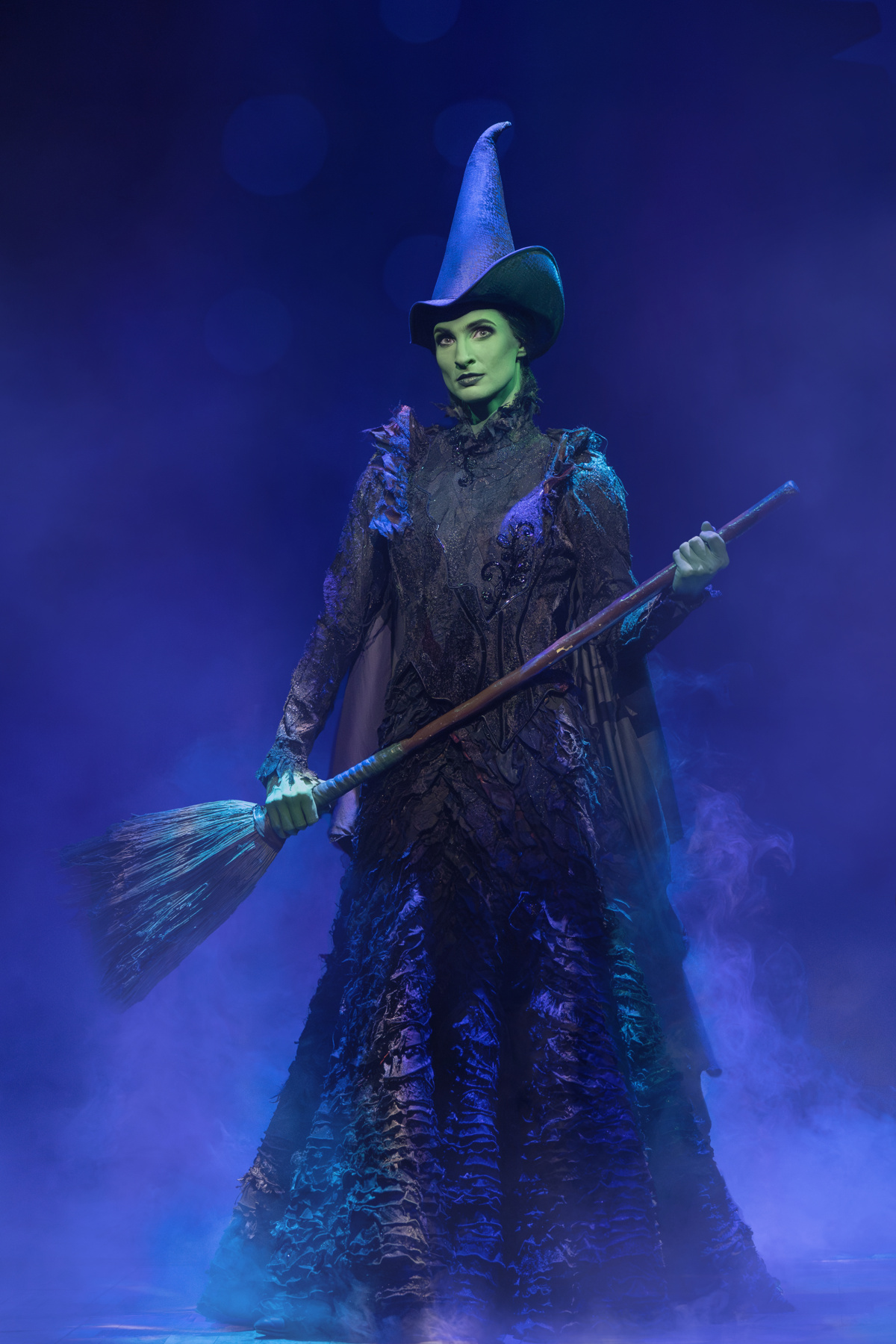
There have been 38 principal performers who have defied gravity as Elphaba on Broadway. Notable alumni include Shoshana Bean, Stephanie J. Block, Ana Gasteyer, Lindsay Mendez, Jessica Vosk, Mandy Gonzalez and Eden Espinosa.
It takes Broadway's current Elphaba, Keri René Fuller, 30 minutes to be greenified. Each year, Wicked's makeup department goes through about 20 palettes of MAC Chromacake in Elphaba's signature shade, Landscape Green.
Elphaba’s spellbinding Act 2 dress is made up of 15 to 20 different fabrics on the bodice, while the skirt uses 290 yards of bias cut ruffle.
Wicked's longtime wardrobe supervisor Alyce Gilbert notes that this particular garment "pushes the border of 'big black witch dress' with the multiple fabric choices, quilting and varying shades of black, grays and small accent colors." She adds: "The design of the skirt, which gives each Elphaba room from the bottom to be very physically active but has a smoothness from the waist that doesn't make them look bulky above the fullness, is very impressive. The many Elphabas over the years have all looked special in that dress, although they were many different heights and proportions."
Seventy-six pointed hats have been used throughout Wicked's Broadway run.

Thirty-four principal performers have enchanted Broadway as Glinda the Good. Kristin Chenoweth “toss toss”-ed her way into theater history when she originated the part, which was written with her in mind. The Good Witch coven also includes Megan Hilty, Annaleigh Ashford, Laura Bell Bundy, McKenzie Kurtz, Kara Lindsay and the production's current reigning bubble benefactor, Emma Flynn.
Oh my goodness! The actress playing Glinda begins the show 30 feet above the stage, and spends between three and four minutes suspended in the air before descending upon Munchkinland for her grand entrance.
Roughly 138 gallons of bubble fluid have been used since Wicked opened at the Gershwin Theatre in 2003.
Glinda's blue bubble gown is adorned with 68,200 hand-sewn sequins and weighs 15 pounds.
Is there such a thing as too many shoes? Witch, please! Glinda has 23 pairs of heels on display in her Shiz dorm room.
Glinda sports five headpieces throughout the show. There are roughly 500 to 600 gemstones per tiara that are set and silver plated.

Nearly 350 costumes are currently housed at the Gershwin. There are 238 costume changes from top of show to curtain call.
Six costume shops, four shoemakers across four different countries (Spain, Italy, Nova Scotia and the United States) and six milliners are responsible for making the Ozmopolitan costumes used in Wicked.
There are 64 wigs worn on stage per show, with over 200 wigs housed in the Gershwin that are ready to be used at a moment’s notice.
This shiz is bananas! There are around 30 monkey masks housed backstage.
Wicked uses 144 moving lights, 4,000 twinkle lights and 1,086 controlled fixtures.
Roughly 3,546,000 pounds of dry ice have been used throughout the Broadway run of Wicked, with 400 pounds used per performance.
The set design for Wicked is inspired by the Time Dragon Clock, a prophetic piece of machinery that plays a prominent role in Maguire’s novel. One of the most iconic features of this set is a giant dragon fixture that looms over the stage. The dragon is a pulley system operated by two carpenters, with one moving its head and the other moving its wings.
The word "Wicked" is used 42 times in the show.
Now that we’ve broken down the magic behind the curtain, your trip to Oz awaits! Grab a broomstick and make your way to the Gershwin to experience what makes Wicked so wonderful. We assure you, there’s no place like it.
Get tickets to Wicked!