Two Strangers (Carry a Cake Across New York) Star Christiani Pitts on Manifesting, Motherhood and Instant Chemistry With Sam Tutty

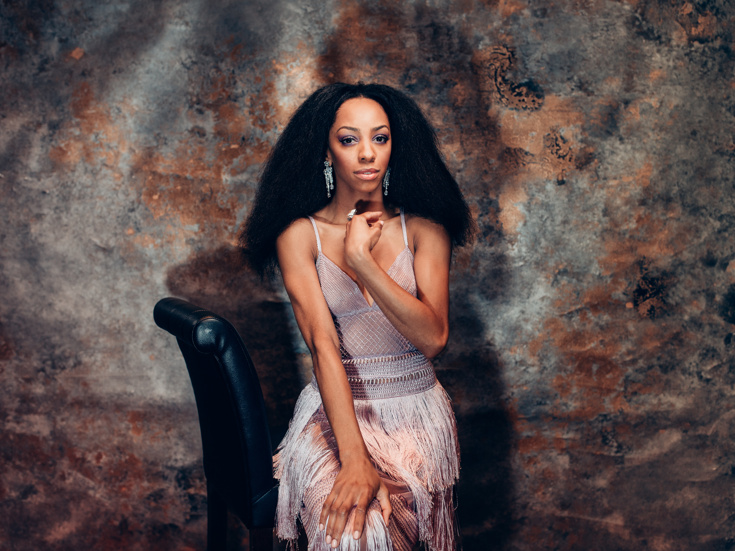
(Photo by Emilio Madrid for Broadway.com)
In Two Strangers (Carry a Cake Across New York), Christiani Pitts plays Robin, a 26-year-old New Yorker struggling to find meaning while stuck in an unfulfilling, monotonous routine. In reality, the 32-year-old actress' triumphant return to the very theater where she made her Broadway debut showcases her as a more confident performer with a stronger sense of self and a newfound freedom on stage. Pitts was drawn to the role of Robin because of the character's relatable experience of depression, which the actress appreciates for not being over-explained in the production. "There's no deep, dark trauma surrounding this young Black girl," she notes, "which we often see in a lot of pieces surrounding Black women—that we have to explore the depths of their pain just to make people care about it for whatever reason."
Pitts' Broadway debut in A Bronx Tale, beginning as an ensemble member before taking over the co-starring role of Jane, was followed by the leading role of Ann Darrow in King Kong. She made history as the first woman of color to play Darrow, working to flesh out the character traditionally depicted as a damsel-in-distress archetype. Now, following the pandemic and the birth of her first child, Pitts is back as one half of the two-hander musical rom-com Two Strangers. The actress spoke to Broadway.com shortly after the show's opening about manifesting Broadway roles, her instant chemistry with co-star Sam Tutty and the television show she's developing inspired by the incredible women in her family.

You made your Broadway debut in the ensemble of A Bronx Tale at the Longacre Theatre in 2017. How does it feel now to be co-leading a production in that same theater?
It feels so cool. This is my first time back to the stage since the pandemic. It's the first time back on stage since I had a child. There are so many firsts, and I've been really scared, honestly, to go back to the stage. It's a different medium than TV and film, and I got really nervous about going back. So to go back in the place that it all started feels like the universe saying, "You're okay and you're held. Do you remember when you were fresh out of college and you were sobbing at the stage door because your dreams came true?" It's that same feeling. Also, one of the greatest actors I've ever worked with or ever had the privilege of watching, I worked with in that theater. I'm talking about Nick Cordero. He is no longer with us, and it feels really special to be able to pass where his dressing room was and walk that stage and have all these really clear memories of what it meant for me as a young actor to watch him carry a show at that age. So now being half of carrying a show, I feel like, "Oh yeah, I got this. I've seen greats do it in this building." It's so special. It's such a special place.

Your daughter was with you on the opening night red carpet for Two Strangers (Carry a Cake Across New York). Do you feel comfortable sharing more about her?
Yes, I'll tell you everything. You're going to have to tell me to shut up about it. She's three. Her name is Zora Makena. She's named after my favorite author, Zora Neale Hurston. She is quite literally the light of my life. This was her first time ever doing any sort of carpet situation. Full transparency, as soon as I stepped out, I immediately got insecure. I was like, "Was this a good idea? Should I have separated work and mom?" That was my initial feeling. Then she got over her shyness and she started posing. The photographers and the journalists were all so encouraging. I immediately felt like, "Oh yeah, it's not different. I'm a human, and this is what I do, and this is my community." All of these people taking these pictures are a part of my community and part of her village. It was incredible. It made me really emotional.
Returning to the Broadway stage, how have you grown or changed as a person and as a performer?
I'm older now, obviously, so I have a sense of self that I did not have when I made my Broadway debut. I was so eager to be good enough for everybody, which served me in a lot of ways. I worked really, really hard and I was really hard on myself, which I think served me in some positive ways. But it also made it really hard to feel safe on stage, because I was so self-conscious and so hyper aware of all the eyes watching. Then something happened in the pandemic, when I realized I make art because it is something that was placed on my spirit from before I could form conscious thoughts. This is who I am as a person. Therefore, it really doesn't matter who's watching it. It is who I am. Now being on stage, I feel so free up there. I'm definitely very hyper aware of putting on a good show, of course, and doing what I believe to be grounded work, but I feel free doing it. That has been the biggest growth, I think, that I've experienced in performance.
How much does your lived experience influence the roles that you go out for?
I definitely like to play characters who have a lot going on, who are a little bit more nuanced than your typical ingénue. I'm really interested in that, which is probably like, "Duh, obviously," but that's just something I'm drawn to. It's funny, with King Kong, I was doing A Bronx Tale, and I was manifesting with my friend Bradley Gibson (we were playing brother and sister in the show). I was saying how I really want my next thing to be like an action film on stage. I was like, "I have no idea what that looks like." I had no idea King Kong was even a thing happening in Australia. Bradley said, "I want to do something incredibly lucrative, a job that may not be new or artistically challenging necessarily, but it will be stable and allow me to venture into other creative endeavors." Neither one of us had any idea what that really meant. Within months, Bradley books Simba in The Lion King, which is easily the most nine-to-five of Broadway. Stable, steady income. I booked King Kong, a show where more than any singing and dancing in anything, I was doing more action, more physical work than I've ever done in my life. Long story short, I think I have this weird way of manifesting what world I want to be in, and then not necessarily knowing where that script exists. Funny enough, with Two Strangers, which I also knew nothing about, I was up here working on a show called Raising Kanan. I play a mom, and it's my first time playing a mom on TV. I just remember thinking, "I want to go back on stage, and I want to do a play that is really book heavy and deals with the gray space that I'm in right now as a new mom." I just feel really gray, sort of out of sorts. I have no idea what that looks like. Although Two Strangers is not a play, it feels like a play with music because the book is so fast and witty and heavy. I think I manifest things by describing a world, and then that world seems to come true in some way.

Robin is not at all in the stage of life where she's having kids or even where she knows what her goals are. What drew you to the character?
I listened to a couple of songs, and then I read the script, and it immediately jumped out to me that she was very clearly dealing with some depression. That word is never used in our script. That word is never discussed in the show. It is just her lived experience, and I deeply identified with being in that place of like, I'm stuck. I really want to be okay, and I'm actively going to work on that every day. It's a struggle, right? It's what a lot of us are doing. Most of us are going through our day, having no idea that we're down. We have no idea that we're actually battling something, and so I just love that it is not deeply discussed. She's just going through the motions. And it's so funny, I smile so much throughout the show. I have a huge smile on my face, which I love, because depression doesn't always look like [what you think] when you hear that word. It can, but it doesn't always look like someone who can't get out of bed. Sometimes it looks like somebody who's showing up to work every single day with a smile on her face. I remember reading the script and being like, "Whoa." Here's a girl who every day is just working really hard at being good. Like, "Every day, I'm going to wake up and try my best to be okay." Why she was dealing with depression was not over-explained. I thought that was so interesting. There's no deep, dark trauma surrounding this young Black girl, which we often see in a lot of pieces surrounding Black women—that we have to explore the depths of their pain just to make people care about it for whatever reason. That's not the case with Robin, and I was so drawn to that. Then I heard more of her songs, and that gray space and juxtaposition with these really fun songs, I was like, "Oh, this is genius. This is really, really good."
"I like to play characters who have a lot going on, who are a little bit more nuanced than your typical ingénue." —Christiani Pitts
When you were cast as Robin for the American Repertory Theater production, was the hope that the show would go to Broadway?
Those cheeky producers, they were like, "Yeah, we don't know" every time. Quite literally, the hope of going to Broadway, for me anyway, dissipated a little bit. I was like, "I don't even want to... I want to enjoy this, and maybe that's not even happening." So throughout the run, it was so free and fun, because Broadway wasn't necessarily a part of it. Then we got extended, and we were like, "People are really responding to our little show." We started questioning, and I remember Vinny [Vincent Michael], who was the Dougal standby, had to go to New York for an audition. He was like, "Guys, I walked past the Longacre Theatre, and I got this weird feeling in my spirit." Trippy. Mind you, there's a whole show in the Longacre when he did this. Then our producer took us out to dinner, and started talking about how he loved the show and the potential future. We were like, "What is going on?" About a week or so after we closed in Boston, we found out we were going to Broadway, and it was freaking amazing. So yes, maybe the hope was always there, but for my own mental health, I was like, "I don't know. I just love Boston." You know what I mean? A.R.T.'s great.

Were you told in person? How did you find out the show was going to Broadway?
In dramatic Two Strangers fashion, Sam and I were asked to come to New York to do a promotional shoot after we closed A.R.T. Again, we're asking, "We're not about to promote a show that's not going somewhere, right?" But they wouldn't give us answers. So we do this shoot. We have this dramatic, "Bye forever, Dougal and Robin. Have a safe flight." I put Sam in his Uber. I'm waving from the bar, and then literally within a week, [producer] Kevin McCollum called him first because of the time difference. Then he called me immediately after, and then Sam and I called each other. It was like phone tag of the four of us communicating, but it was just so good.
What's it been like working with Sam Tutty? The chemistry for a two-hander is so important. Did that come right away?
No lie, no joke, it literally happened right away. I walked into my chemistry read with him, and my acting coach years ago told me to treat auditions like rehearsal, like you already got the job. So that's how I approached him. I introduced myself, and I'm like, "Oh, what's up?" I give him a hug, I'm immediately like, "Let's do this." We had a great audition, laughing, it was so much fun. Now mind you, I'm at work, so he was great, but I was like, "This is a part of the job." He tells a story that I walk in like, "I am Robin." He's like, "You were all confident, you immediately made me feel like, 'Well damn, let me step up.'" That's our bond, teasing each other, but holding each other emotionally. He has become such a great friend to me, and he has been emotional support. This is my first time living in the city with just me and my baby, and Sam doesn't have any kids, right? But he's like... I could just go on forever, but my point is he is one of the greatest friends and greatest scene partners I've had, and it happened immediately. We connected so much. When I left the audition—I thought that I was six feet taller than him because I was wearing Docs and he was wearing flats—I was like, "Damn. I'm not going to get this, but that guy is going places." Because that was one of the best auditions I've ever had. We have been thick as thieves ever since. It's been wonderful.

Did you make any tweaks to the character of Robin to make her feel more authentic to you?
I did. Also, I just want to take this moment to do some major, crazy, special shoutouts and love to Dujonna Gift, who played the role in London. Robin has two patter songs that I struggle with with my American dialect that I have naturally, and she did it like a boss, so shout out to her. She's fricking phenomenal, she's incredible. She laid such a solid foundation that anything that I was able to come in and tweak was simply the New York of it all, the Brooklyn of it all. So first and foremost, shout out to her for laying such a solid foundation for me to build off of. But yes, there were some British things and then there were things also about, again, going back to this young girl who is dealing in a gray space. There is a way in which everybody processes things, but I think something that I found about my Robin is that she's not the surface level. What's the word I often see when they describe the character? No nonsense. I think those things can be very boxy and limiting. If you've seen the show, you see how much mess Robin has gotten into in her life. She deals with a lot of nonsense. She's got a lot of nonsense going on. But we were able to dive deeper with some of the tweaks, and find ways to give understanding to her harder exterior that is deeper than, she's from Brooklyn. Some of the nicest, friendliest golden retriever-like people I know are from Brooklyn. So what about her specifically makes her a harder shell? And dialecty things, things that were really just authenticating her speech and her experience, and they were so open to it.
Down the line, what are you manifesting next?
The truthful answer is that I am just so present in this show right now, because the two-hander of it all has me like, "Whew." The breathing room for other things is gone. We may be able to come up for air at some point. I am writing a show right now. I'm developing a TV show, and I've finished the pilot. I just feel like now I want to play the role, which is ridiculous, but if I could put it on my vision board, that show gets picked up. And even if it's not me playing the titular character, that it just goes crazy, and that it does really well and all that good stuff. It's a dramedy. It's loosely based off of my mother, who in real life was a cop in the 1980s in the narcotics division. She often went undercover as a sex worker, as all sorts of different things. She and my Aunt Winnie integrated the police force at that time. They were the first Black women to join that division. I picture it being Blaxploitation style. Like that of the ‘70s, but the show will take place in the ‘80s. Fingers crossed, 2027 here we come.