5 Reasons A Few Good Men Commands Attention on Broadway
Tom Blyth, Bradley Whitford and Krysta Rodriguez lead a revival that puts the audience on jury duty

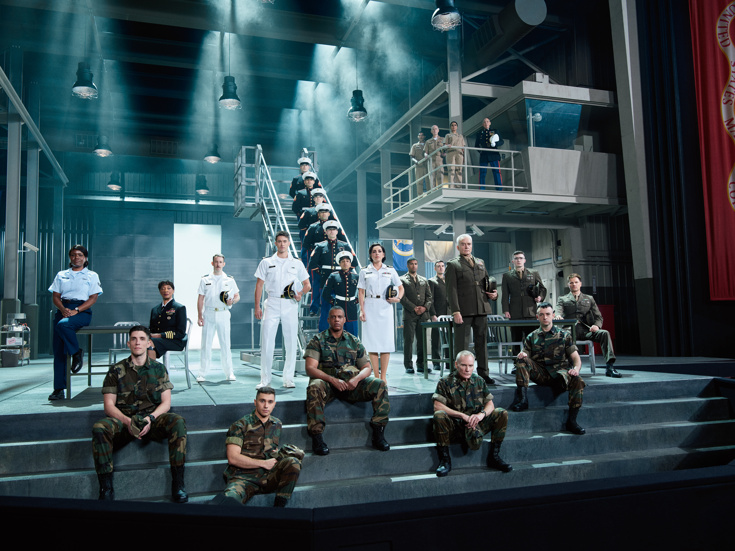
(Photo: Emilio Madrid)
What to Know
- Tom Blyth, Bradley Whitford and Krysta Rodriguez lead Broadway’s A Few Good Men
- Aaron Sorkin’s updated script and Michael Arden’s direction put justice, loyalty and command under scrutiny
- The Lincoln Center Theater revival invites audiences to think like jurors in the military courtroom drama
The questions of justice remain unresolved in Aaron Sorkin’s A Few Good Men, now playing at Broadway’s Vivian Beaumont Theater. Whether you know the movie by heart or are discovering the story for the first time, this Lincoln Center Theater revival puts the clash between conscience and command front and center. Directed by Michael Arden and starring Tom Blyth, Bradley Whitford and Krysta Rodriguez, the production pairs sharp dialogue and courtroom confrontations with an unsettling question: What happens when loyalty becomes an excuse to look away?
1. Fans of the film are in for surprises.
Sorkin has updated his script, preserving the classic lines fans are waiting for while finding new ways to keep audiences on their toes. When the confrontations arrive, part of the thrill is hearing how these actors deliver familiar lines. Amplified by the Beaumont's pristine acoustics, the passion and power of Sorkin's text reinforce the idea that A Few Good Men was "always meant to be a theatrical experience."
2. More than a few good actors.
Blyth makes a charming Broadway debut as defense attorney Lt. Daniel Kaffee, growing more invested in the case along with the audience. Across the courtroom stands a familiar face in Sorkin's world: The West Wing Emmy winner Whitford, who made his Broadway debut in the original production of A Few Good Men, plays Col. Nathan R. Jessep, giving Blyth a formidable opponent. Broadway mainstay Rodriguez brings intelligence and determination to Lt. Commander JoAnne Galloway. The supporting ranks are equally stacked. Nick Blaemire’s dry humor as Lt. Sam Weinberg offers welcome breathing room, while Michael Oberholtzer makes prosecutor Capt. Jack Ross a worthy match for the defense. Thom Sesma brings quiet gravity to Capt. Matthew Markinson, suggesting the weight of everything he knows and cannot easily say. Especially arresting is John Zdrojeski, whose unnerving certainty as Lt. Jonathan Kendrick makes unquestioning obedience feel chillingly personal. Lavel Schley and Collin Kelly-Sordelet give the accused Marines distinct personalities, balancing military discipline with the vulnerability of young men whose futures are on the line. Together, they make one of the most well-rounded squads on Broadway.
3. This production wants you thinking like a juror.
Arden has described the audience as the production’s jury, an idea that adds another dimension to the courtroom drama. Testimony asks to be weighed. Certainty invites scrutiny. His approach, developed with Sorkin, treats the play as a work still open to discovery, with the language driving the action. Hearing the arguments live gives them new force.
4. The story gets told all over the stage.
The military demands that its members stand at attention, and Arden commands yours across the Beaumont’s expansive stage. Together, Arden's staging and two-time Tony-winning scenic designer Dane Laffrey’s set draw your eye beyond whoever is speaking to the larger picture taking shape upstage or in crowded corners. Sorkin’s dialogue rewards close listening; Arden’s direction gives your eyes work to do as well.
5. Following orders raises questions worth asking.
Two Marines stand accused of murder, but establishing what happened is only the beginning. A Few Good Men asks who bears responsibility in a system that demands obedience and what happens when protecting that system takes precedence over protecting the people within it. Following orders becomes a question of conscience. As the defense challenges the chain of command, the divide between what is permitted and what is right becomes harder to ignore. The questions follow you out of the theater.
Get tickets to A Few Good Men!